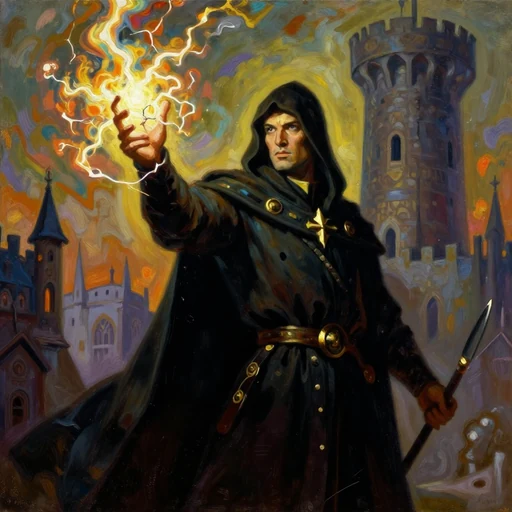
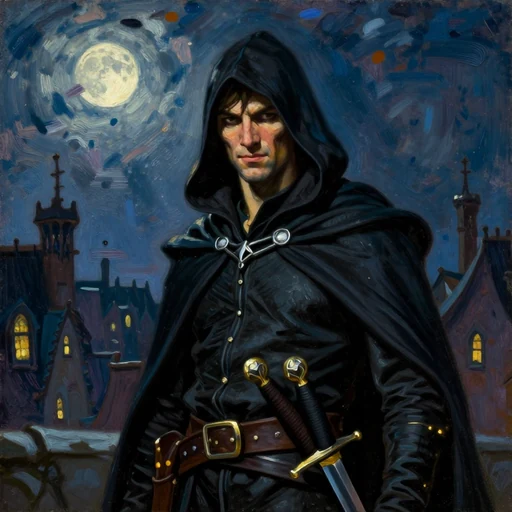
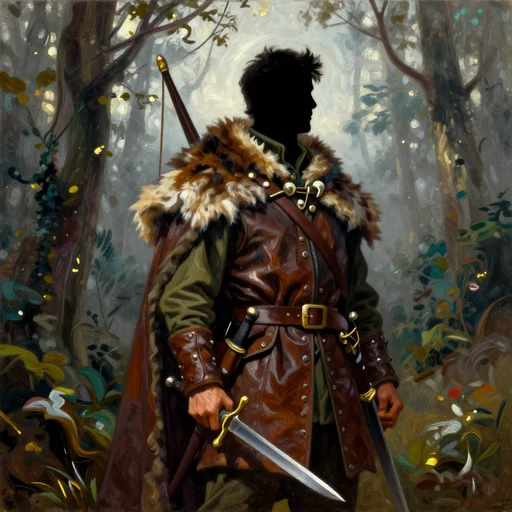
A text MUD with a modern web client. Aardwolf and DragonRealms in one deep, mostly solo game: difficult, but not impossible, with quality-of-life everywhere you look.
Open now as an invite-only alpha for players 18 and over. Nothing will be wiped before a full release.
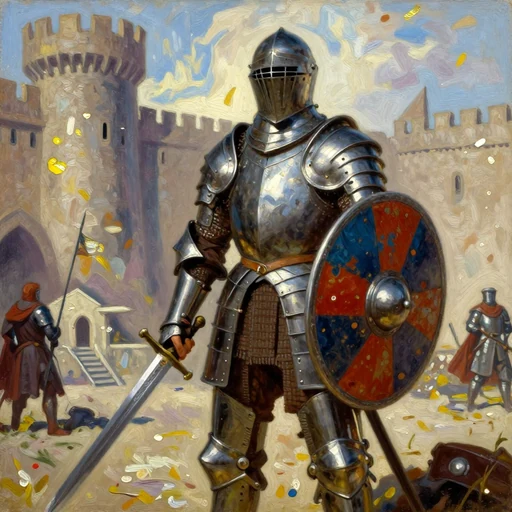
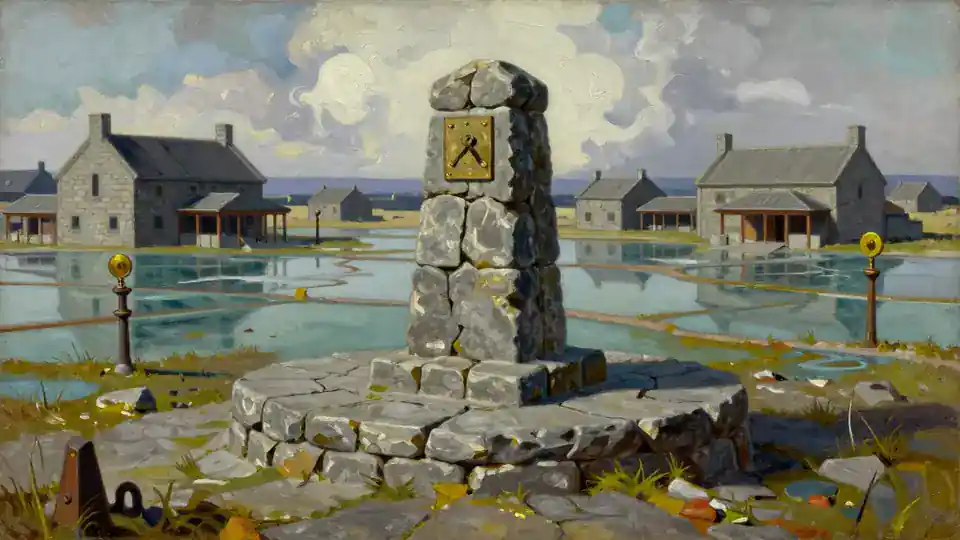
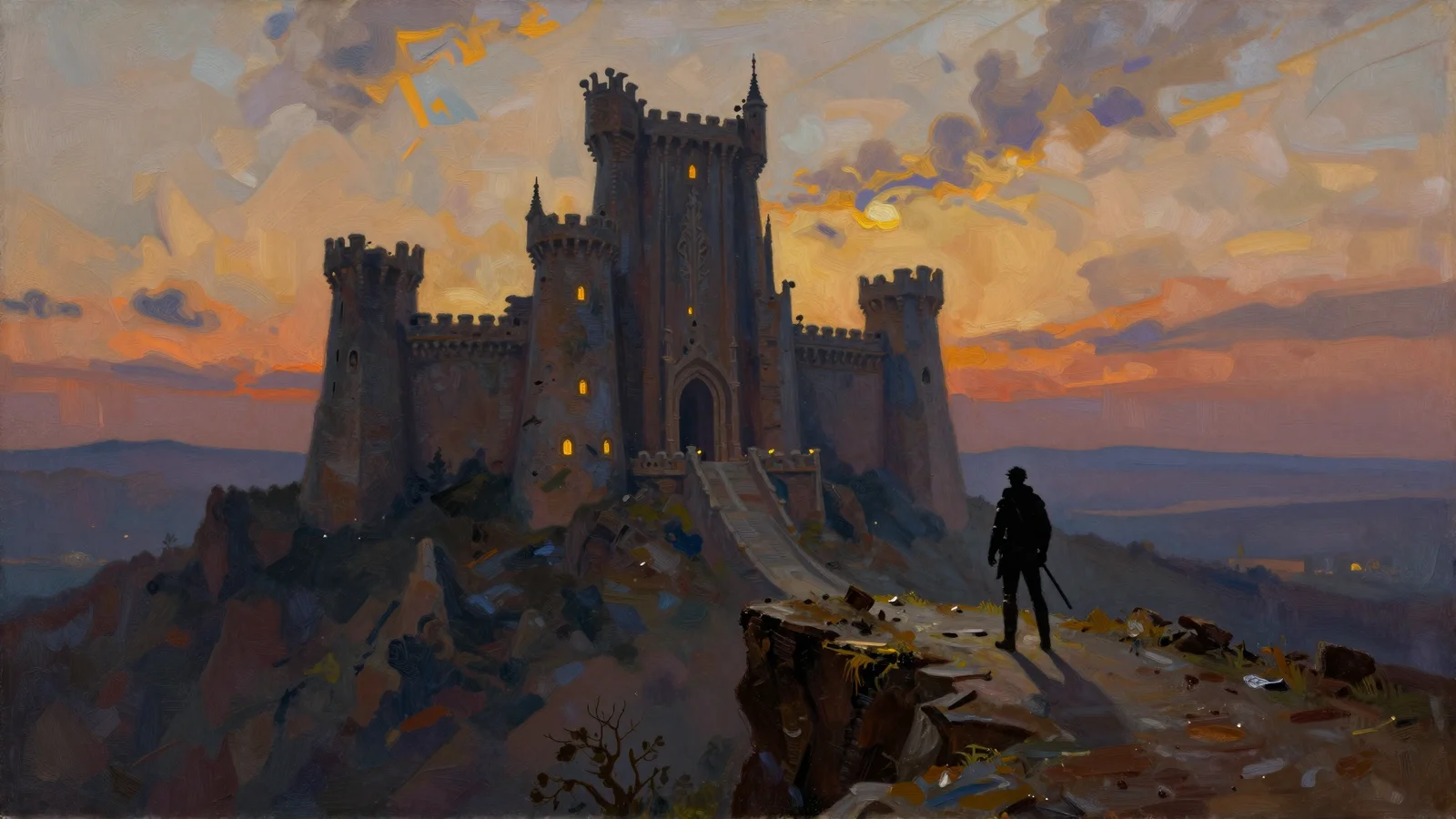
The gate plate: a blind scribe writes the world by lamplight.
What it is
A world of words you read, walk and fight through, set out like a book.
Blind Scribes is a MUD: a multiplayer world made of text. You type where to go and what to do, and the game answers in prose. It takes the spine of Aardwolf (levels, quests, campaigns, remort, maps, a bestiary, autoloot) and the fighting and learning of DragonRealms (roundtime, range, telegraphed heavy blows, skills that grow through use), and puts them in a client that reads like an illuminated manuscript.
It is built to be played mostly alone. A hired hand can stand beside you, and group bosses can be opened and fought by one player with a hand. Groups, clans and a five-player raid are there when you want company.
It is meant to be hard, but never unfair. An on-level boss in decent gear is tuned so that you win about half to three quarters of the time. Ordinary creatures cost real health, and pulling too many can kill you. Death itself is light: you wake in Millbrook's Mender's Hall with everything you carried, minus a little experience and coin.
114 zones
1,542 rooms
631 quests
50 levels
6 classes
9 races
8 hub towns
Aardwolf and DragonRealms smashed together, with a lot of quality of life. Difficult but not impossible. Many areas, each with mobs that fit it. Many items, with real stats.
The game
What you will find, from your first ten minutes to your fiftieth level and past it. The margin notes are the commands you type in the game.
A first hour that teaches
A new character is asked one question: muster, or skip. The Muster Yard is a ten-minute training ground. You look around and read the map, size up a creature, fight it your class's way, loot it, answer a heavy blow, flee, drink a draught, set your wimpy and rest. Deaths in the yard cost nothing.
Walking the core path pays once: level 2, a little gold and two healing potions. Optional schools wait in the yard after that, to take in any order. Skipping costs nothing, and you can come back from any safe room at any level.
In the game
tutorial
tutorial go
help tutorial
newbie <message>
New hands again. One of them tried to loot the trainer.
Fights you read and answer
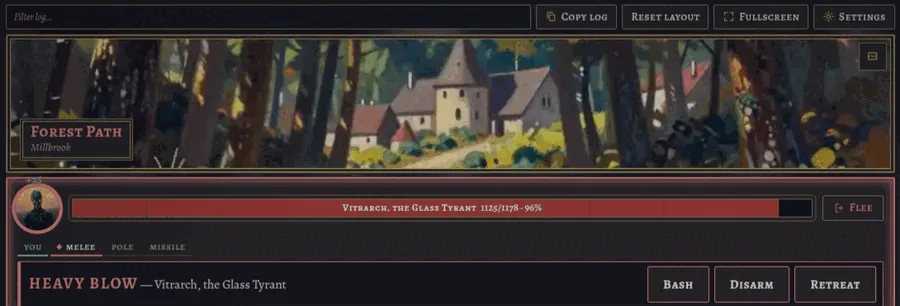
Every fight runs in rounds of two seconds. What you type goes off on the next round in place of your swing. Heavy weapon blows and the great spells commit you for longer: that is roundtime, and while it runs you cannot flee or step back.
Every fight also has a range: melee, pole or missile. A spell opens a fight at pole range and the creature has to close on you. A spear reaches from pole, and a bow shoots from any range. You can advance or retreat a band at a time.
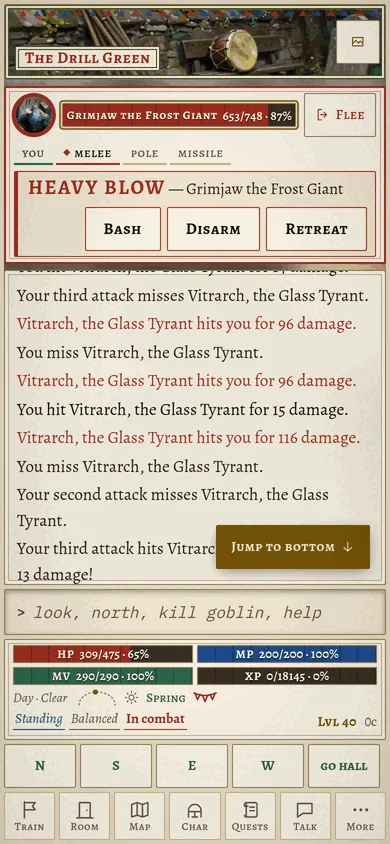
Bosses fight in a rhythm. A few ordinary blows, then a wind-up, and on its next turn a heavy blow lands at three times the force, unless you answer it in the round between. Since v0.16 the Instrument-Bearer, the Weir Warden and the Organist wind up too, so the level 31 to 40 stretch gives you a moment to answer instead of a wall to outlast. Try it:
Grimjaw the Frost Gianta boss of level 14
polemelee
Grimjaw the Frost Giant hits you.
Grimjaw the Frost Giant rears back, gathering itself for a heavy blow!
Heavy blow
An illustration of the web client's wind-up strip. In the game the outcome is rolled, and consider tells you your odds for each answer before you start.
The real thing, from the web client: the foe card, the range band and the heavy-blow strip.
In the game
consider <foe>
retreat
advance
bash
stance
help windup
help roundtime
help range
help verbs
Wrote “heavy blow” forty times today. My wrist would like a word with Grimjaw.
Eight towns and a long climb
Levels run from 1 to 50 across 114 zones and eight hub towns, each with its own trades, people and roads out. The people keep hours now: they go home at dusk, some shops shutter, and the morning after an invasion the square shows it. Every weapon has a blow of its own, every guild a ladder of skills and spells, and skills grow the way they do in DragonRealms, through use, with field experience and mindstates. Three quiet ones, scholarship, appraisal and performance, never swing a sword: they read the walls, judge a creature before the fight and play to whoever is listening.
Quests come from people: ask them what they know, and they hand out work. Many out-of-the-way zones have someone living in them who knows the place. The Questor gives bounties and campaigns, and a long chain called the Proof runs from level 33 to 40.
Fifteen hundred rooms and every one wants its own adjective. Now they want a bedtime.
Master Hesketh says the walls will talk to anyone who stands still. I have stood still for an hour. The wall is rude.
Remort, the Mantle and the circles
At level 50 the story of the Mantle of the Ascendant asks you one question, and you seat one of its three endings. Then you can remort: begin again at level 1 as any class, and any race if you like, with every attribute one point higher for good. Your old class is mastered, and its abilities keep unlocking beside the new one's. You keep your skills, gear, money, titles and quest points.
Remort opens places, not power. Gates such as the Skybreak cairn, the Rust Stair and the ring under Corthal open to one remort, and the Drowned Stair to two. The Sounded Coast lies down the river from an empty cradle-berth. About twenty quests appear only once you have begun again, and the ending you seated changes what you see in four mirror zones.
Inside each guild you climb circles, read off your skills, up to circle 150. Circles open each guild's two branch abilities, a title every tenth circle and, at 75, the door to your guild's reliquary. Past circle 101, and again past 126, the guilds ask for a remort.
In the game
remort
circle
circle up
pass <way>
help remort
help branches
Begin again, they say. I have been beginning again since the lamp went out.
At fifty: the Quires, the Codex, the seasons
The Quires are a six-tier ladder on the lists. Any boss you have beaten can be wagered again at a quire from 1 to 6. The first two are a gentle way in. From the third, each copy carries an affix from that week's Fair Copy, the same for everyone, so bests compare. A counted win pays marks, spent at the lists' stall on crafting reagents, two cosmetic titles and a small, capped upgrade past a drop's own ceiling. The public board, ranks, shows who has gone furthest against which boss.
The Codex gathers what the game already knows about you into nine chapters, from the Bestiary to the Record, with titles at their milestones. Experience earned past level 50 is tallied there as the margin, toward a title. It never turns into power.
Seasons are world tales that run for about six weeks, with tokens, a stall and a title. Counted Quire wins move a season too, so a level-50 character can carry one alone. A season buys looks, not power.
In the game
wager <boss> <n>
wager quires
stall
ranks
codex
season
Quire six. I am told this is “a gentle way in”. I am told many things.
Crafting and work orders
Three trades, forging, outfitting and remedies, run a recipe ladder from level 1 to 50. Materials come off creatures, off a shop's shelf or out of the ground, and some rooms have a gathering spot of their own. Wearables come out crude, fine, superior or masterwork, and a reagent gives a piece its affix. A crafted piece is built to tie the best ordinary drop of its level, never to beat it: a dependable road, not a shortcut.
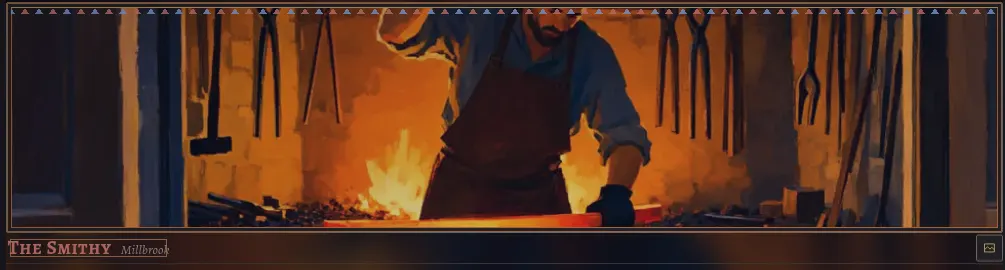
Each trade now has a rank you are called by: prentice, journeyman, craftsman, master and past master. A journeyman can salvage a spare uncommon or rare in the field, anywhere, into scrap. A craftsman can set a pair, two reagents on one piece for a prefix and a suffix, and a master's masterwork carries the maker's mark outright. Twelve new pieces fill the holes in the gear ladder at 31 to 46, and three patterns can be bought at the Quire stall. Fourteen workshops show the bench being worked, and a man with bandaged knuckles by the Warriors' Yard fence has opinions about all of it.
Every workshop posts work orders in three tiers, easy, challenging and hard, paid in the materials' worth plus labour. After fifty orders your masterwork carries your name.
The Smithy's own plate: a smith at the bench, not a generic room.
In the game
recipes
craft <recipe>
craft <recipe> with <a> and <b>
salvage <item>
appraise <item>
forage
commissions
help disciplines
A masterwork hood, by me. The hood is fine. It is a fine hood.
Homes and clans
Buy a deeded estate: a cot from Millbrook's Moot House from level 10, then a house or a lodge from Datum's Plot Office. It is reached from any safe room, with a storage chest, furnishings, guests and a description that is yours alone to write. Rent is taken per term you spend online, and nothing is ever confiscated.
Clans can be founded from level 20, with ranks, a treasury, a hall, a channel, clan levels, a weekly quest and a goal board. Each week the clan that best defends a town from invasion becomes its Warden, with its banner over the square.
In the game
home buy
home
furnish <item>
clan found <name>
ct <message>
clan wardens
Rent taken per term online. I have not been offline since the Muster.
Quality of life, everywhere
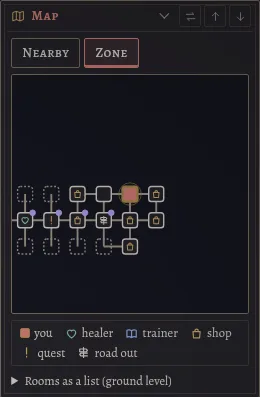
Autoloot and autogold are on from the start, and so is autodraught: a new character begins with it set to 50%, drinking your best healing draught for you at that mark, on your own turn and the draught's own clock. Change the mark or turn it off any time; a Draught 10s chip in the status bar counts down until the next one is ready. Fourteen two-letter shorthands run the word you mean (sc for score, fl for flee, ca for cast), while the weapon verbs stay whole so a half-typed word never swings a blade. The map draws the rooms you have explored, map zone the whole area, and runto walks you anywhere you have been.
The Day-Book keeps three small daily goals and one weekly one, a bonus lane with no streaks and nothing locked behind it. The Questor draws campaigns of your own, and every few hours a global quest races the whole server. Hire a hand, buy a mount, light a camp in the wild, and ask help search about anything.
In the game
auto on
autodraught 30
help shorthand
map zone
runto <place>
goals
quest campaign
gquest join
hire
camp
Autoloot is on. I asked whether it can also autowrite. It cannot.
A web client worth reading in
The client is set like a manuscript, in a serif made for long reading, with small-caps titles and every room's painting in a gilt frame. It comes in night vellum and day vellum. A slim strip above the room shows the sun or moon's arc, the weather, the season, the tide on the coast and the head of steam underground. The whole page tints gently with the hour and the weather, and the eight towns change to a painted night scene after dark.
Big moments get a small ceremony: a boss card with its portrait the first time you meet one, a toast for a level or a deed, and an illuminated card when you graduate from the Muster. The Map pane draws your explored zone as an inked plan. Sound cues, synthesized in the browser, are off until you turn them on. On a phone the panes fold into one row of buttons, with every target a thumb's width.
In the client
Settings: theme, Effects, Show artwork, Sound cues
Map: Nearby or Zone
This parchment is hairy, the ink is thin, and the night is long.
A storyteller, and a quiet score
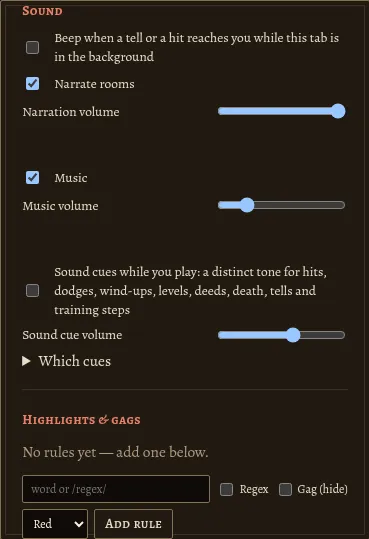
Tick Narrate rooms in Settings and a storyteller reads each room to you aloud: all 1,542 of them, in a day voice and a night voice. Only the room you stop in is read, so a long walk plays just its last room, moving on cuts the voice off, and look reads it again. It is off until you ask for it.
Music is on at a low volume, and the browser plays nothing until your first click or key press. Six slow tracks follow the zone, a fight crossfades to battle music, a boss gets a track of its own, and a few seconds after the fight it eases back. It ducks while the storyteller speaks. Each has its own volume in Settings, and both switch themselves off in screen-reader mode. For the record, the voice is a synthetic one and the score was composed by an AI music model; neither is a person. Telnet and Mudlet never hear either.
A scorched cave mouth opens into the mountain's heart, and the heat rolls out of it in slow waves that arrive at about the pace of breathing. The stone around the opening is glazed to a depth of a finger. Something enormous shifts in the dark, and the shifting takes a long time to finish.
Hear a room: one room of the 1,542, read aloud in the storyteller's day voice, with its text beside it.Settings, Sound: the storyteller and the score each have a switch and a slider.
In the client
Settings > Sound: Narrate rooms, Narration volume, Music, Music volume
help narrate
help music
The storyteller reads my rooms better than I wrote them. I wrote them blind. It is still unsettling.
Built for screen readers and MUD clients
Screen-reader mode turns every line into plain words: no box drawing, no decorative banners, a spoken prompt, and the map as a list of rooms with the steps to each. The web client has its own live announcer, and a heavy blow's warning is always read first in a busy round.
Nothing is web-only content. Every ceremony has a plain-sentence telnet equivalent, with opt-in banners, word wrap at your window's width and an ASCII fallback. The server speaks GMCP for Mudlet and other clients (room info for mappers, vitals, combat, skills, items, quests, groups, goals) as well as MSSP, and clients that report a screen reader switch the mode on by themselves.
Telnet is open. Point any MUD client at play.blindscribes.com, port 4000, or play in the browser; it is the same world either way. New characters still need an invite code. How to connect.
In the game
config screenreader on
config banners on
config wrap
config charset ascii
help screenreader
I write by touch and by memory. The lamp is for the visitors.
Port 4000 is open. Mind the draught; I have not yet learned to close a door I cannot see.
Classes and races
Six classes, each with a guild hall, a skill ladder and a branch of two abilities earned by circle. Nine races, each with one perk that is always on.
Warrior
The toughest. Plain blows and bash, a shield and heavy armour.
The Shieldwall: shield wall and charge.
Mage
Spells and no weapon, opening from range with magic missile.
The Wardbreakers: Mana Tap and Repulse.
Rogue
A dagger and backstab.
The Poisoners: envenom and tumble.
Cleric
Club and shield, and healing from the first level.
Mercy: Mending Hymn and Rebuke.
Paladin
Sword and shield, bash, and some healing later.
The Oathkeepers: Lay on Hands and taunt.
Ranger
A dagger and kick, and a twin dagger in the off-hand once Dual Wield comes at level 15.
The Wardens: snare and Call Hawk.
Nine races
Human
Adaptability: 10% more experience from kills.
Elf
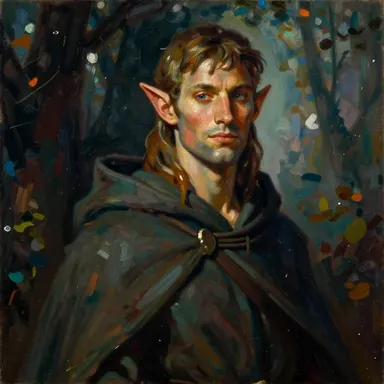
Arcane Affinity: more spell power for healing and harm.
Dwarf
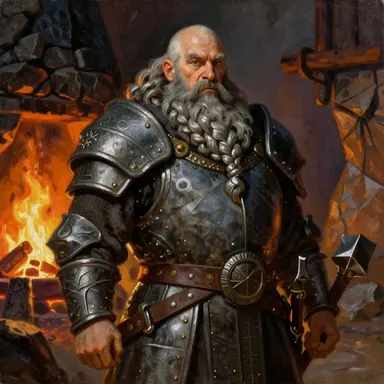
Stoneborn: innate armour against physical blows.
Halfling
Elusive: a better chance to hit, and a chance to dodge outright.
Orc
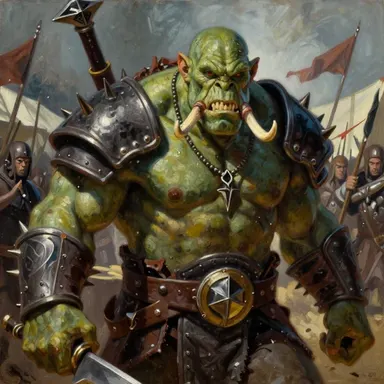
Bloodlust: extra damage on landed melee blows.
Gnome
Quick Reflexes: a better chance to hit, and a chance to dodge outright.
Half-elf
Fey Heritage: more spell power for healing and harm.
Dark elf
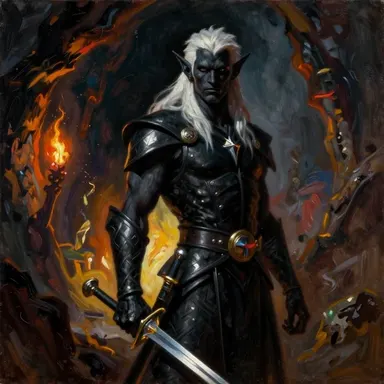
Venomous Strikes: extra damage on landed melee blows.
Troll
Thick Hide: innate armour against physical blows.
Race is chosen at creation and can change at a remort. None of this is perfectly balanced yet: at levels 41 to 50, halflings and gnomes win more boss fights than the target allows, and the game's own help says so.
The world
Eight hub towns, from a mill town on a brook to a cavern town round a great waterwheel, in the order you will reach them. The quotations are the game's own room text.
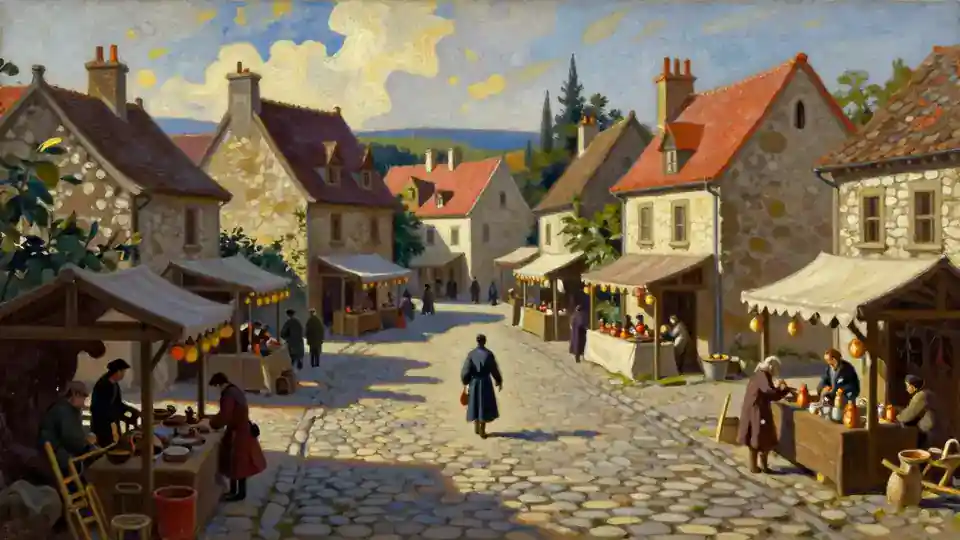
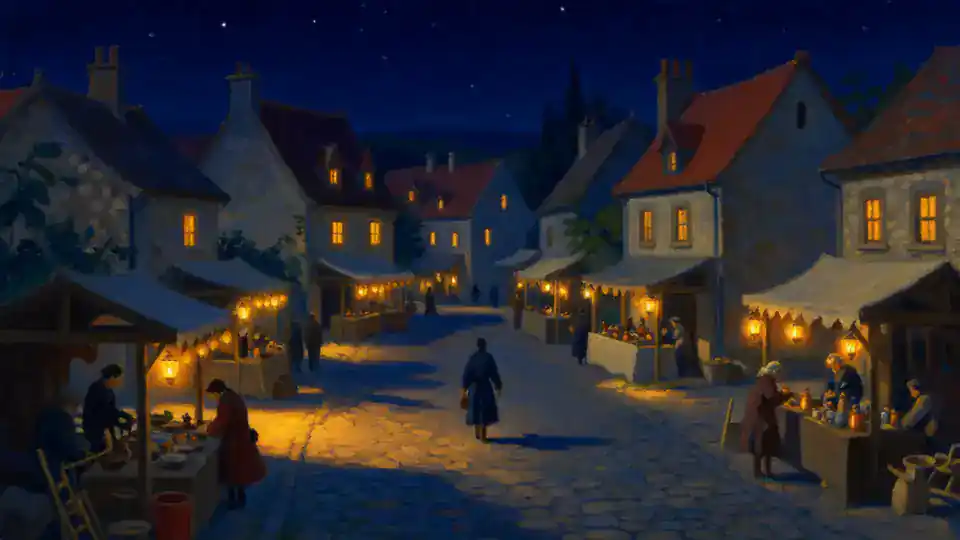
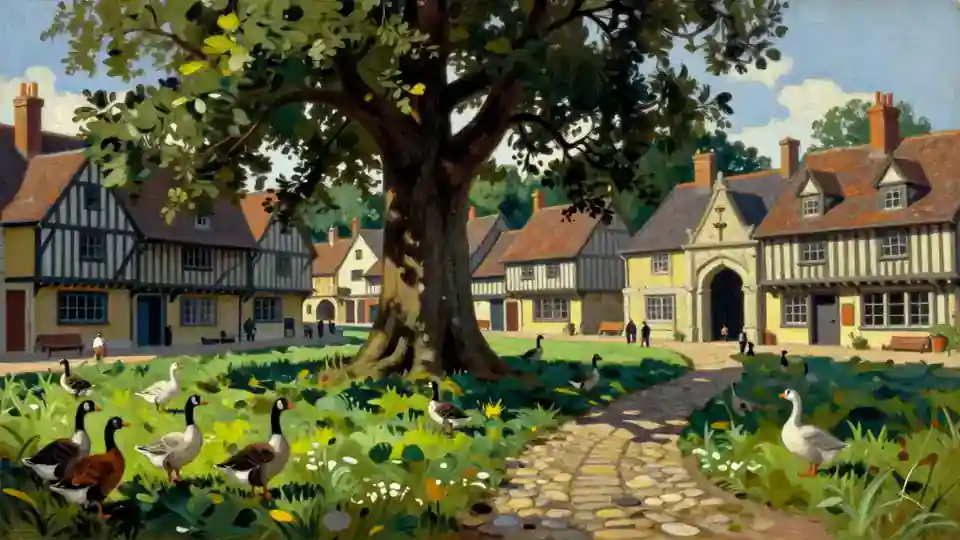
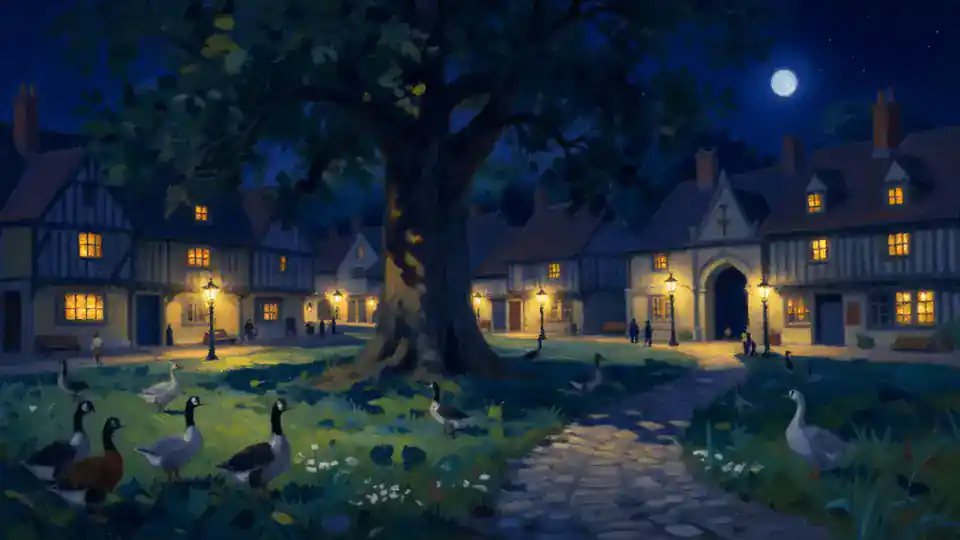
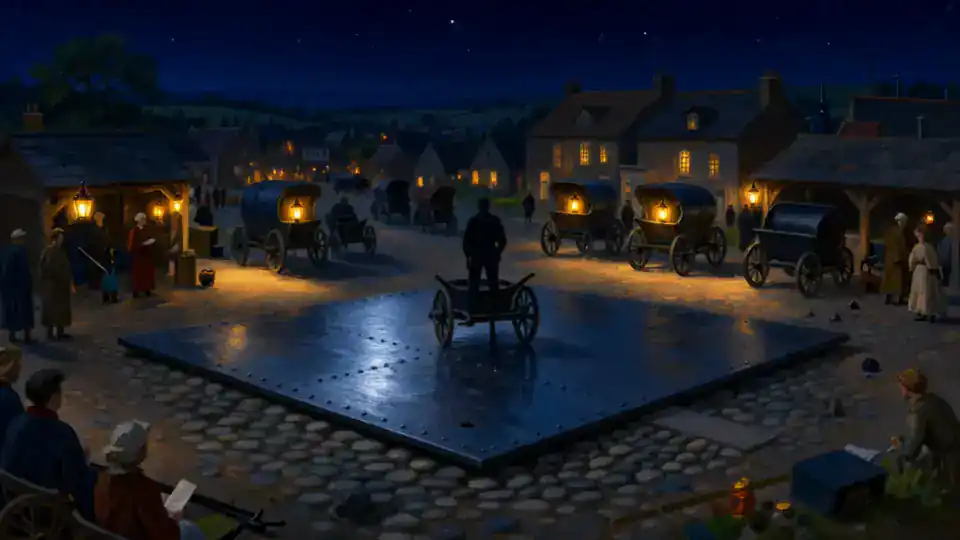
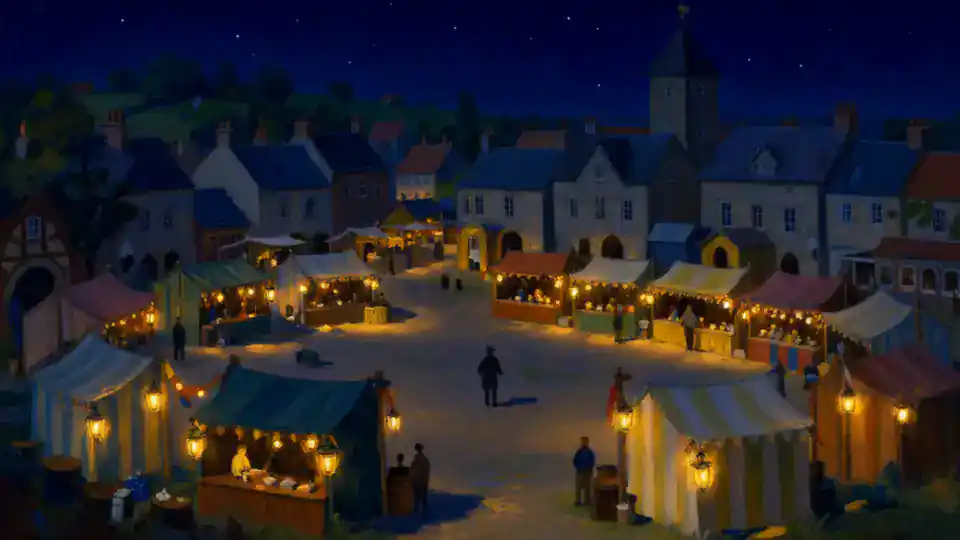
The towns below follow the page's colours: by day in day vellum, by night in night vellum.
Millbrook
levels 1–6
Cobblestones ring the market stalls here, worn into shallow dishes where three generations have turned the same corner.
Where everyone starts: the Muster Yard, the Mender's Hall, the Tilt and the first estate office.
Oakhanger
levels 11–20
North of the market a broad green lies between the town's half-timbered houses, grazed to velvet by geese.
A chartered forest borough that does everything by the writ. Some of its ways are shut by paper, and its Green holds the lists.
Scaleford
levels 21–30
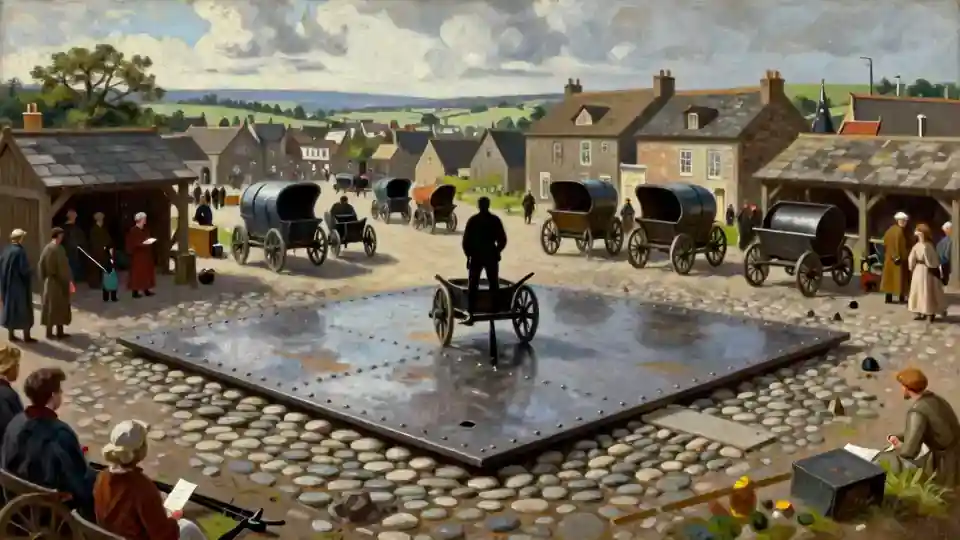
A plate of riveted iron forty feet square is sunk flush into the cobbles at the centre of the ground, and the whole town has arranged itself around the wait.
A drove town round its weighhouse, with a Hiring Rail for hands and the road north to the Debatable Land.
Fairstow
levels 26–35
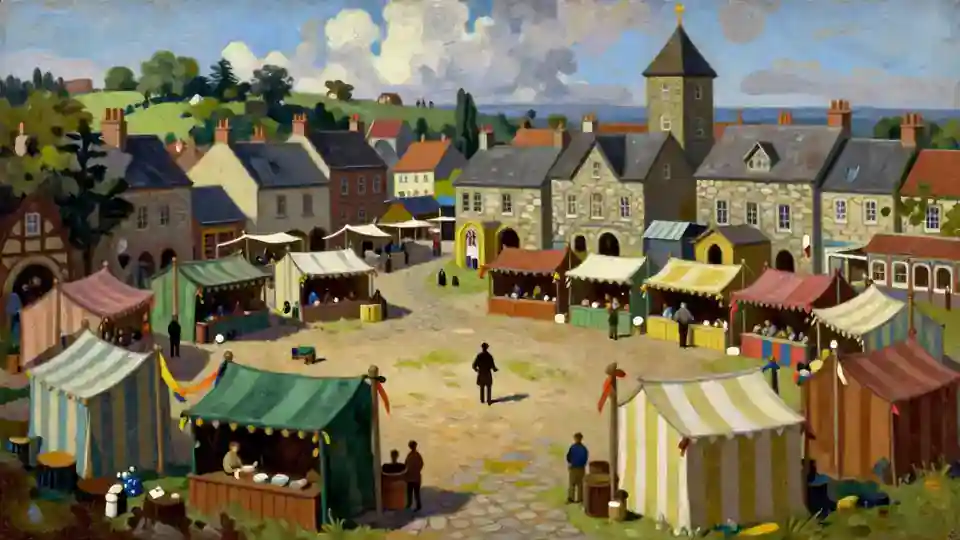
It is the largest room in the world that is used one day in three.
A hundred and fifty trestle stalls, a Hiring Fair, a saddlery, and archery butts that hold the lists on fair-day.
Datum
levels 29–38
This is the zero-mark of the whole survey: every distance in the country is reckoned from the stone underfoot.
A surveyors' outpost on the glass, home to the Register and the Plot Office, where houses and lodges are sold.
Gullhithe
levels 31–40
Out on the mole a great bell swings on its frame in the wind, and makes no sound at all.
A harbour on the Salt Coast, where everything is arranged around the tide.
Stannock, the Tin Stair
levels 41–50
Very high above, a row of lit windows is counted off tier by tier, like a stair of small stars.
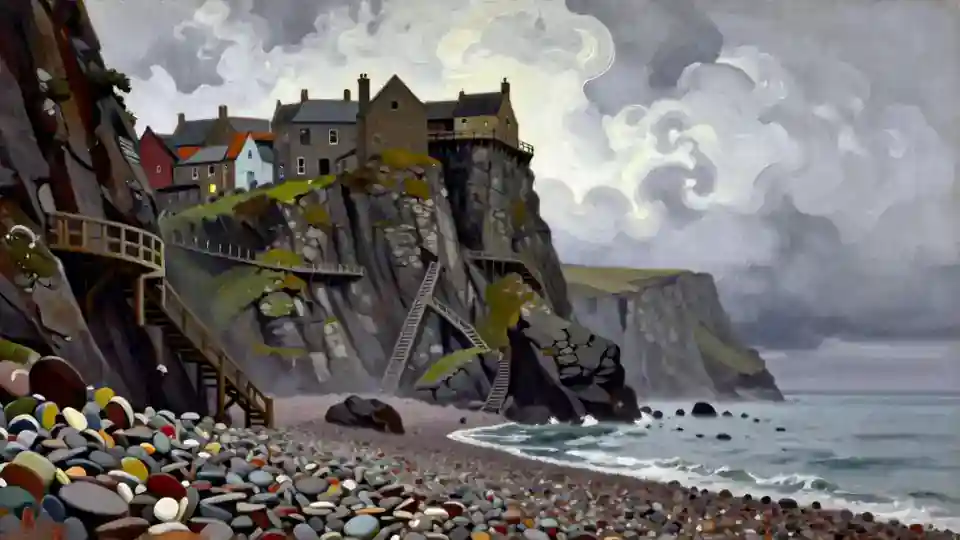
A town on a cliff that goes up into cloud, reached from the Strand by chains and a seawater lift.
Turnwick
levels 43–50
Water pours over its rim with a sound like slow applause, and the spokes go by overhead in a steady procession.
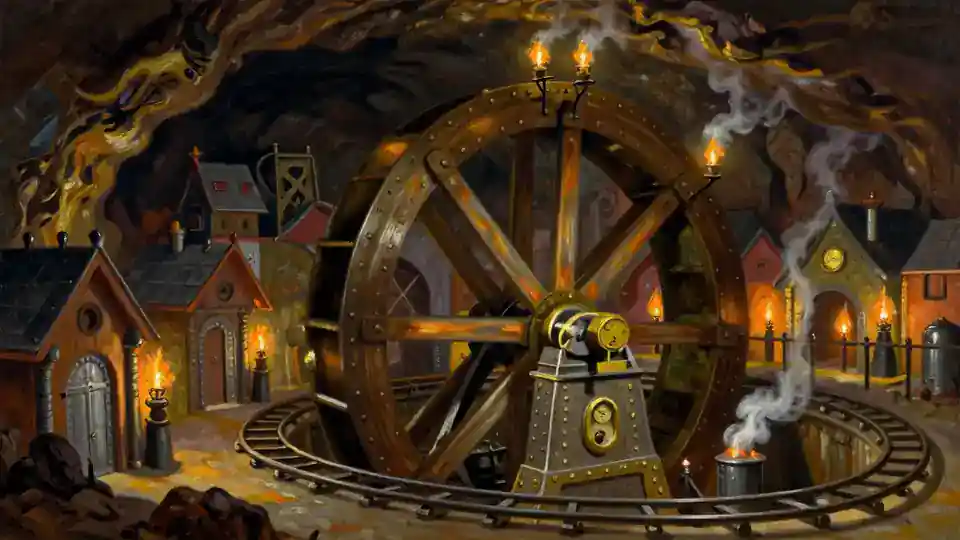
An underground town round the Great Wheel, at the head of the Underworks.
A few of the 114 zones
The first steps
The Hedgerows1–4
The Brook Meadows1–7
The Weeping Citadel1–8
Sable Marsh1–10
The Sunken Crypt1–10
Blackwood Hollow4–11
The teens
Frostpeak Foothills5–15
Ashfall Caverns8–17
Stronghold of the Iron Hand11–20
The Soughs12–18
The Kite Ledges12–18
The Hand's Pass14–20
The long middle
Dragon's Reach16–25
The Husking Fields18–27
The Amber Orchard21–30
The Wheel Pits21–27
The King's Lodge24–30
The Cable Walk26–31
The thirties
The Rain Wards30–36
Thornhold31–40
The Debatable Land32–38
The Hammer Ponds34–40
The Barrow Heath34–40
The Salt Level36–40
The high forties
The Hollow Crown41–50
The Cinderwrack Reach41–50
The Drowned Customs42–48
The Heartwood45–50
Corthal Under45–50
The Second Sky48–50
After a remort
The Sounded Coast45–50
The Depths, Regeared48–50
The Loom, Rewound48–50
The Deep, Sounded48–50
Screens and paintings
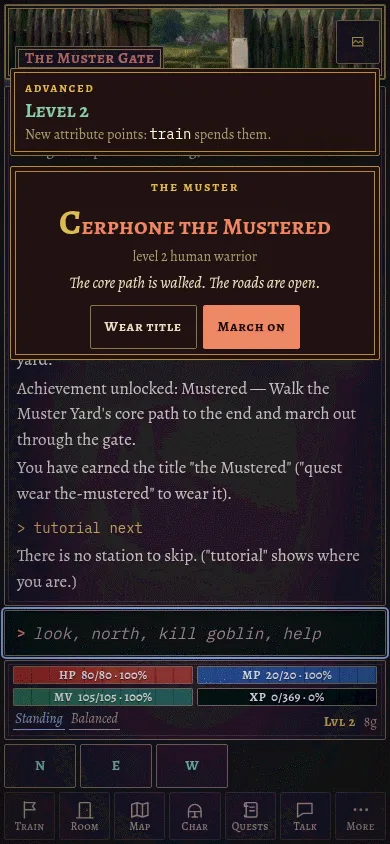
The web client on a phone, and some of the painted portraits of the bosses waiting for you. Select any picture to see it larger.
Graduating from the Muster.
A heavy blow, in day vellum.
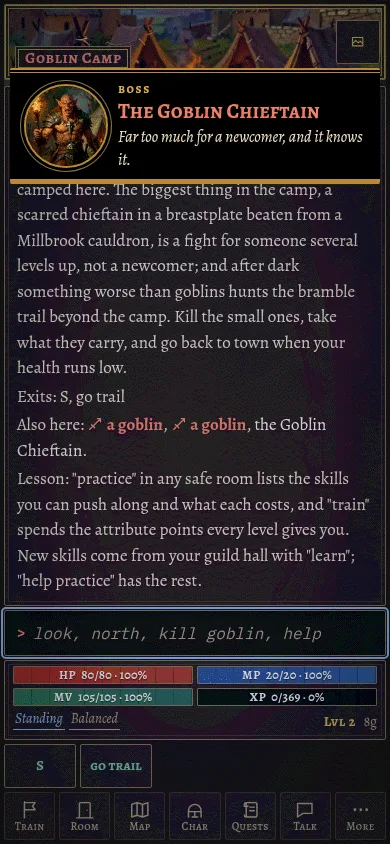
A boss card, the first time you meet one.
The explored-zone map.
Some of the bosses
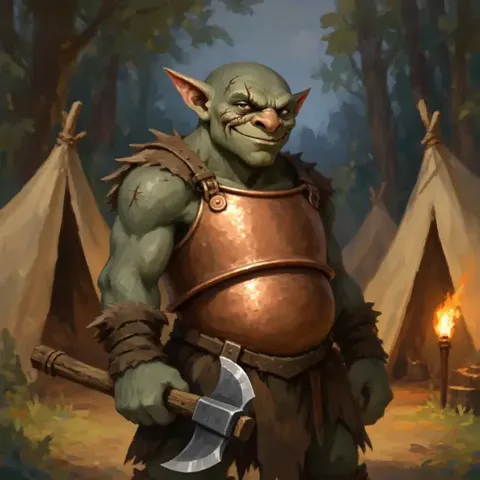
The Goblin Chieftainlevel 5
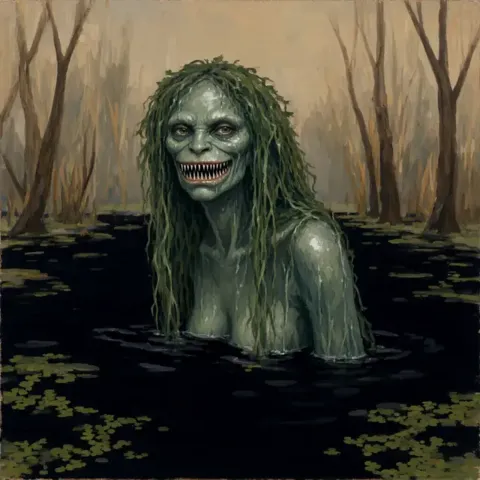
The Marsh Witchlevel 7
The Greenteethlevel 8
Old Skitter, the Rat-Kinglevel 9
The Barrow Kinglevel 10
The Weaverlevel 11
Grimjaw the Frost Giantlevel 14
The Cinder Wyrmlevel 16
The Old Kitelevel 18
Pyrrhaxis, the Ashen Drakelevel 22
The White Hartlevel 24
The Wheel-Wifelevel 27
The Drowned Sovereignlevel 28
The Organistlevel 36
The Hollow Kinglevel 47
The Iron Governorlevel 49
How to play
The alpha is invite-only for now, and for players 18 and over. You need a code to make an account, and either a web browser on a computer or a phone, or any MUD client. Nothing to install.
How to get an invite
A code is free, good for one new account, and the name you choose is filtered the same as anyone else's.
A Discord and a contact address are coming.
Open the game
Go to play.blindscribes.com, enter your code and choose a name. Names that read as staff, or that trip the profanity filter, are refused.
Choose a class and a race, then muster or skip. If you are new to MUDs, muster: ten minutes in the yard teaches everything the first hours ask of you.
When you are stuck
Type help for what you need now, help search <word> to look inside every page, or newbie <message> to ask everyone online.
Telnet and Mudlet: open
Bring your own client. Point Mudlet, TinTin++, MUSHclient or plain telnet at play.blindscribes.com, port 4000, or port 4443 for an encrypted connection. New characters need an invite code, which you can ask for with the form above.
In Mudlet, add a profile with the server play.blindscribes.com and port 4000, or port 4443 with Secure ticked. The server speaks full telnet, with GMCP, MCCP2 compression, NAWS and charset negotiation.
With a screen reader, type config screenreader on and every line becomes plain words; clients that report a screen reader switch it on by themselves.
A new character is asked for an invite code right after choosing a name: type it at the prompt Invite code:, in capitals or not, with or without the dash. The game is for players 18 and over. In the game, help telnet repeats the ports, and help color and help wrap set colour and line width.
What's new
Each release has a name, the way a manuscript's parts do. Newest first.
v0.21.15
The Hourglass
Cooldowns you can see. Nothing else changed.
A skill or spell that has to wait shows a small bar under your health, mana and moves: its name and the seconds left, draining away.
On a phone too, and in the Vitals pane when the bottom bar is off.
Screen readers hear nothing new; the game's own lines still say when an ability is ready.
v0.21.14
The Marginalia
More to read at the top of the world. Nothing else changed.
Each of the 26 zones of level 40 and up, past the two hubs, has two new things to read: a rota on a bench, a ticket on a bell, a rule on a flagpole.
look or study says what each one is in a sentence; read gives the words.
Every one stands in a lit room that is not a boss's, and reads the same with the screen reader on.
v0.21.13
The Pricking
The web client on a phone, made steadier. No words in the game changed.
A dropped connection reconnects by itself and asks only for your password; the name is filled in.
Past level 10, a short phone folds the painting away and shows more of the story.
A boss is announced at once, and tables read one row per line on a phone.
Settings is in four groups: Display, Play, Sound and Screen reader.
v0.21.12
The Manicule
Eleven more people who notice where you have been. No quest, reward or fight changed.
In each of the eight hub towns one person past level 10 asks you to go and read or see one thing, and says something new when you have.
The three lair wings each have someone at the mouth: a winch-minder, a brakesman's daughter and a runner-wright, each with a face.
The strangling bine's painting is now a bine.
v0.21.11
The Ruling
The web client sits better on a phone. No word or number in the game changed.
On a phone the status lines fold into fewer rows, so the story keeps more of the screen; tables in the log use a slightly smaller type.
The Bank is one tidy button in each safe room; typing map brings the map forward; level and deed cards wait until you close a sheet.
Twenty-four more places past the first hour have a painting for the night.
v0.21.10
The Likeness
Eleven people past level 10 now have a face. No number in the game changed.
The six residents of the Gloss, the armourer and the knife-keeper of the Chapter hall, the stair-keeper, the King's Rider and the Quire-Marshal's clerk each have a painted portrait, with a small round one beside their name in the log.
v0.21.9
The Rubric
Past level 10, somebody wants something done and notices when it is. No number in the game changed.
In 79 zones one resident lists a favour: something to read, a place to see, or the zone's boss. Come back after and they greet you differently, with one more thing to ask about. Nothing is handed over or counted.
The last 17 zones past level 10, the eight hubs among them, now have a night of their own.
Trying to kill someone you can talk to, outside Corthal, now says only that they are not your enemy.
v0.21.8
The Gloss
Words for the world past level 10: nights, weather, things to read and six more people to talk to. No number in the game changed.
72 zones of level 11 and up sound different after dark, each in its own rooms. Underground zones get nights with no sky in them, and 24 open zones have lines for their own rain, fog or storm.
76 zones that had nothing to read now have a slate, a board, a ledger or a cut stone. look says what it is and read gives the words.
Six zones where nobody would talk now have a resident at the safe room, with five topics each.
v0.21.7
The Hatching
A colour-safe palette for players with red-green colour blindness, off unless you turn it on. Nothing else in the game changed.
In the browser, Settings has a "Colour-safe palette" switch under Theme. It re-inks rare and epic items, the talk channels and a few other colours so they stay apart under protan and deutan colour blindness, in both themes, and every colour still meets the contrast standard.
v0.21.6
The Register
The game read aloud, from the first screen to level 50. Screen-reader players hear words, not symbols, and a prompt that says what changed. Nothing about combat or your character changed.
Over telnet, type reader at the name prompt to turn screen-reader mode on before any colour is sent; in the game it is config screenreader on.
The prompt says only what moved, and Enter alone says every number. In a fight the enemy comes first, and a heavy blow's warning is the last line before the prompt.
In the browser, Tab then Enter reaches the command line and Escape returns to it, pane names are headings, and Settings has a screen-reader switch.
v0.21.5
The Catchword
A page for level 50, and screen-reader lists that read as words. Nothing about combat or your character changed, and the first hour is the same.
help fifty names what the level cap opens, with a page for each; quire, hoard and margin now say where to look.
With a screen reader on, from level 11 bestiary, recipes and chase read as sentences, with no symbols.
titles and equipment wrap to 80 columns from level 11, and ten more worn "two hundred years" lines were re-written.
v0.21.4
The Collation
Help and lists that fit the hour you are in. The long help pages are split into short ones, the lists stop at your level, and a few worn phrases in the world's texts are gone. Nothing about combat or your character changed.
help craft, help remort, help codex and help commission are now several short pages each; help mantle and help work find the right one.
From level 11, recipes and bestiary show what is near your level; recipes all and bestiary all show everything.
Twelve rooms were re-written and re-recorded for the narrated client.
v0.21.3
The Fair Hand
A tidier first hour. The opening screen reads in order, the hints speak in one voice, and the help pages read as whole paragraphs at 80 columns. Nothing about combat or your character changed.
deeds lists your achievements; areas shows the zones for your level and areas all every zone.
In a workshop, recipes lists that workshop's recipes first; recipes all lists the rest.
Plainer words for races, classes, the Smithy and consider; the web client keeps the room title clear on a phone.
v0.21
The Guildhall I
A place to be good at something that is not a sword. Three quiet skills, scholarship, appraisal and performance, have ranks and a title for each, and they teach and tell rather than fight. They pay no experience or gold and change no combat number.
study the hidden lore in each hub: forty-five old things, five to a town, give up more as your scholarship grows.
appraise a creature before the fight to learn how far it strikes from, its heavy blow and what you have seen it drop.
perform a ballad, jig, riddle or recital for an audience.
pose at someone in the room, and keep a short profile that shows in whois.
Master Hesketh, in Millbrook's Scriptorium, will talk you through all of it.
v0.20
The Marginalia
The Codex gains a tenth chapter, The Almanac: it ticks off each town you have stood for when the crier called an invasion, and three new titles and a marked almanac leaf come with it. Nine rooms, one in each town, now read differently in spring, summer, autumn and winter (and are narrated that way), and 120 townspeople answer your questions in plainer, more particular words.
v0.19
The Threshold
Strangers can now ask for an invite from this page, and we answer by hand. Telnet gains an encrypted door on port 4443. The game is for players 18 and over, and says so at character creation. Season Two stands beside Season One, and the opt-in play statistics are kept under a scrambled id, not your name; the alpha notes say what is kept and for how long.
v0.18.1
Open Line
The door has a second handle. Telnet and MUD clients are welcome at play.blindscribes.com, port 4000. Invites are still by code, on telnet just as on the web.
v0.18
The Reckoning
The levels 21 to 30 were measured honestly, and found harder than they should be.
Four more bosses telegraph their big blows. The Decoy-Man, the Hop-Factor, the tally-keeper and the Amber Sovereign now wind up first, with a tell that names you. Answer the tell and the blow is yours to survive.
The lower-twenties wall is gone, for every class. The rogue and the paladin gained most.
v0.17
The Almanac
The towns keep a day, and a year. No combat number, price or drop moved.
Townsfolk keep their own hours. Twenty-nine named people walk home at dusk and back at dawn, and you hear them go.
Shops that shutter. A few close at night and name an open one: "The Turner's is shuttered till dawn; the Bark Mill is open."
A clock that remembers. The world clock survives a restart and counts the seasons. time tells you which.
Festivals, heard in every hub, not only Millbrook.
Invasions leave a mark. A notice on the board, a word from the crier, and a square that looks different the morning after.
The eight hub towns were rewritten, and the storyteller re-recorded to read them.
v0.16.1
The Fair Copy II
The game learns to be heard, and to be read at a glance. No combat number moved.
Narrated rooms. An optional storyteller reads every room aloud, with different readings for day and night. Settings > Sound, off until you tick it.
Music. Six quiet tracks that follow the zone, with their own battle and boss music, a crossfade into a fight and a fade back out. On at a low volume, silent until your first click.
Shorthand. Fourteen two-letter commands do what you meant (sc, fl, ca and eleven more). help shorthand lists them.
The draught timer. A "Draught 10s" chip, a spoken line for screen readers and two small sound cues show when the next healing draught is ready.
A better first hour: plainer hints about full packs, resting, unlit rooms and recall. Rares are underlined and uncommons set in small caps, so rarity reads without colour. Plates that had cropped out their subject were re-centred or repainted.
v0.16
The Bench
Crafting grows a second half, and three bosses stop being a wall.
Ranks and masterwork pairs. Prentice to past master in each trade. A craftsman can craft with two reagents for a prefix and a suffix on one piece; a master's masterwork carries their mark.
Field salvage. A journeyman can break a spare uncommon or rare into scrap anywhere, no forge needed. Mark-bought gear can no longer be melted down for gold.
Quire stall patterns. Spend marks on a named reagent, or on one of three recipe patterns you only need to read once. Twelve new pieces fill the gaps in the gear ladder at 31 to 46, none of which beat a drop.
Boss wind-ups you can answer. The Instrument-Bearer, the Weir Warden and the Organist now telegraph a heavy blow, and consider tells you your odds of a retreat. Win rates for a careful reader rose from about 15% to about 60%.
Brokenhands by the Warriors' Yard fence will talk shop about salvage, ranks and patterns. Fourteen workshops got their own bench plate.
v0.15
The Open Door
Inviting a friend got easier and safer; the door itself stayed latched.
Invite codes can carry more, and the site now says in one screen how to get in.
Behind the door: a capacity alert, a rehearsed restore from backup and a moderation ladder, each tried for real rather than assumed.
v0.14
The Margin Notes
Menus that fit what they point at.
A creature's menu in the Room panel offers only what that creature does: a shopkeeper lists and sells, a trainer teaches, a hostile fights, a passerby talks.
The pack and gear screens sort, filter and act per item, with Appraise and Compare, and a carried-weight bar you can see coming.
Nine small friends now stand about the world with greetings of their own, from Sauce at the Hollins Inn to a snapping turtle called Snapfui.
v0.13
The Pigments
Items wear their rarity everywhere a name is printed.
Common stays plain ink, uncommon is green earth, rare azurite, epic and legendary have their own pigments, on every list, shop, corpse and pack. "(better than yours)" flags an upgrade.
An item card on inspect, an icon for every item, and descriptions for forty-two items that had none.
The Hoard, a ninth Codex chapter, remembers every epic or legendary you have held. A rare corpse find remembers who found it first.
v0.12
The Burden
A feel change, not a content one: roundtime is priced by the weapon against the hand.
A weapon is a choice, not a free upgrade: every weapon has its own balance and weight, so a big blade costs more rounds to swing.
A full pack slows you; a tired arm swings slower. The roundtime line says why: "(heavy)", "(burdened)" or "(winded)".
Player portraits for your own character arrived in v0.12.1.
v0.11
The Fair Copy
A design pass on the client, nothing new written. The room painting is a proper plate now — taller, art-directed, captioned on a rule underneath instead of a box across its corner — and it steps aside the moment a fight starts so the log keeps its lines. The roundtime banner reads at a glance (a bigger numeral, a plain word, no idle flicker) and only flashes "Ready" after a wait long enough to be worth saying. The right-hand panes and the toolbar lost most of their buttons: one menu where there were three, "Copy log" and "Reset layout" folded into Settings, the Map pane's empty state given words instead of blank hatching. Sixty of the oldest portraits and two dozen room paintings that had lost their subject to an old crop were repainted, worst first, in the same house style. The screenshots above and the ones on this page are the after set.
v0.10
The Second Impression
Polish on what had already shipped. A small round portrait by an enemy's first mention in the text log, tap or hover for the full painting; every visited room on the Zone map, not just the mini-map, a click-to-travel stop; a text pass closed a handful of small wording gaps, including a bare gold, which now answers with your coin count; a teaching sentence for the cleric's rotation, no number moved; and an art audit repainted five mob portraits and ten room scenes that had drifted from their own descriptions. Close behind, in a hotfix: combat lines trickle onto the log instead of landing all at once, a second move typed mid-round gets a plain line instead of being dropped silently, and slower, more readable combat rounds.
v0.9
The Errata
A second way of checking balance: a scripted player with a human reaction model, run alongside the usual one. The upper Quires were retuned against it, the four hardest wind-up bosses eased by a cut to their sustained damage, and the paladin's old zero-wins-in-92 result at quire 3 traced to a clumsy spell rotation rather than its own numbers. A new character now starts with autodraught already on at 50%. Also: new portraits for the mage, rogue, ranger, paladin and warrior, a proofreading pass across player-facing text, every visited room on the mini-map now a click-to-travel stop, trainer to walk you to your own guild hall, a bare y for quick answers, and the Codex's eight chapters each unlocking a keepsake on completion.
v0.8
The Colophon
The level-50 endgame. The Quires, a six-tier ladder on the lists with a weekly Fair Copy of affixes, marks, the stall and the public board. The Codex. Seasons that count at fifty. Also: account delete, autoloot on by default, two new telegraphed heavy blows at levels 8 and 12, and the eight bugs the endgame playtest found, fixed.
v0.7
The Wicket
Ready for strangers. The game took the name Blind Scribes and the gate gained its painting. A sign-up name filter, report for problems with another player, backups that survive a crash, a health check, and a careful way to remove someone's data on request. The alpha opened, invite-only, at play.blindscribes.com.
v0.6
The Long Middle
Levels 12 to 40 filled in. Eight new zones, each with a boss that winds up, from the Soughs to the Salt Level. The Proof, an eight-step chain from level 33 to 40. Quests for six zones that had none. A crafting ladder all the way to 50, work orders in three tiers, gathering spots and the maker's mark. A balance pass.
v0.5
The Second Hand
For the soloist. Hired hands became real companions, with health and a wage. Three group wings and the legendary chase can be finished alone. The Day-Book, campaigns, the lists and the wager, wind-up bosses from level 4, camping, a friendlier map, and five rare wanderers to find.
v0.4
The Limning
The web client redrawn as Vellum. A fight HUD with the heavy-blow strip and range band, a sky that follows the hour and weather, painted night scenes for the eight towns, ceremonies for big moments, an inked zone map and sound cues. Ninety-nine bosses repainted. Matching opt-in banners for telnet and screen-reader players.
v0.3
First Light and The Muster
Group bosses and re-derived balance, and the Muster Yard: a training ground with six schools for every new character.
What comes next
The Reckoning, the open line, The Threshold, The Marginalia and The Guildhall I are out. Next we read who comes through the door before building anything new. Both seasons start on the owner's day. A few race and class pairs are still too strong at 41 to 50, and we say so plainly in the alpha notes.
Questions
What is a MUD?
A multi-user dungeon: a shared online world told in text. Rooms are described in prose, and you act by typing commands like north, look or kill goblin. Blind Scribes keeps that heart and adds a web client with buttons, bars, a map and paintings, so you can tap as well as type.
Do I need to install anything?
No. The game runs in a web browser on a computer or a phone, at play.blindscribes.com, and all the fonts and art come from the game's own server. If you prefer a MUD client, point it at play.blindscribes.com, port 4000.
Can I play alone?
Yes, and most people will. A hired hand fights beside you and can guard you from blows, and the group wings can be fought by one player with a hand. Groups, clans, a global quest and a five-player raid are there when you want them.
How hard is it?
Hard enough to need thought. An on-level boss in decent gear is tuned for you to win roughly half to three quarters of the time, and ordinary creatures can kill a careless player. consider tells you what you are walking into. Below level 6, death costs nothing.
What happens when I die?
You wake on a cot in Millbrook's Mender's Hall, fully healed, with everything you were wearing and carrying. There is no corpse run and no lost level. From level 6 a death takes a tenth of your current level's experience, from your progress toward the next level only, and 5% of the coin you carry, capped by level. Coin in the bank is never touched, and a friend who reaches you within about a minute can revive you.
Will my character be wiped?
Nothing will be wiped before a full release. Balance numbers will move under you while the game is tuned, and we will say so in the notes when they do.
Can I use Mudlet, or a screen reader?
A screen reader, yes: the web client has a live announcer, and config screenreader on turns every line into plain words. Mudlet and other MUD clients connect at play.blindscribes.com, port 4000, or 4443 for an encrypted connection, with an invite code like everyone else. More on telnet.
Is the game up?
The status page at status.blindscribes.com shows whether the server is answering right now. If it says the game is down, it is down for everyone, not just for you.
How do I tell you about a bug?
In the game, where it happened: bug <what happened>, typo <the words> or idea <your idea>. Each report is saved with your level, your room and the time, so send a typo from the room where you saw it. Say what you typed and what you expected.
How old do I have to be?
Blind Scribes is for players 18 and over. You confirm it when you make a character.
Can I delete my account?
Yes. Type account delete in the game (your password, then a typed confirmation), or ask an admin. It leaves the live game at once and every backup within 30 days.
Conduct and privacy
The short version. In the game, help conduct and help telemetry say the same at length.
The rules
Be decent on gossip, newbie and in a tell: no harassment, no hate speech, and don't share anyone else's personal information.
report <player> <what happened> tells the admins about someone. An admin answers within 2 days.
Admins can mute a player's channels, ban an account, or remove one entirely on request.
Admins never ask for your password. If anyone does, don't give it, and report them.
You must be at least 18 to play.
Your data
We keep your account, character, mail and home: the saves needed to play. IP addresses appear in rotated access logs, the server's event log and, if ever needed, the ban list. The telnet front door's address log is kept 14 days; the website's access logs rotate at 10 MiB, five files.
The event log's login counts feed a weekly digest for every account, whether or not you opted in. The digest is counts only and stays with the owner; it is never published.
A request for an invite keeps your contact only until we have answered, and no longer than 30 days; backups that hold it are gone within 30 days after that. The website's access log records the address the form came from, not what you wrote.
There is no ongoing log of what you say. A report carries a snapshot of the last 30 lines of public gossip and newbie chat, kept as evidence; nothing from tells, says, clan or group chat.
Play statistics under a scrambled id (not your name) are off twice over: only if the server keeps them and only if you said yes. What you say is never kept; counts, never your id or name, reach the owner's weekly notes. Statistics are kept about 90 days.
Daily backups are kept 14 days on the server and 30 days on a machine the owner controls. A removed account leaves every backup within 30 days.
No trackers, no analytics and no third-party scripts on this site.